Harvard’s Wine-and-AI Symposium Covered Everything — Except How Buyers Will Find You
The best minds in wine and data science spent three days on how AI will change winemaking. The question most wineries actually need answered barely came up.
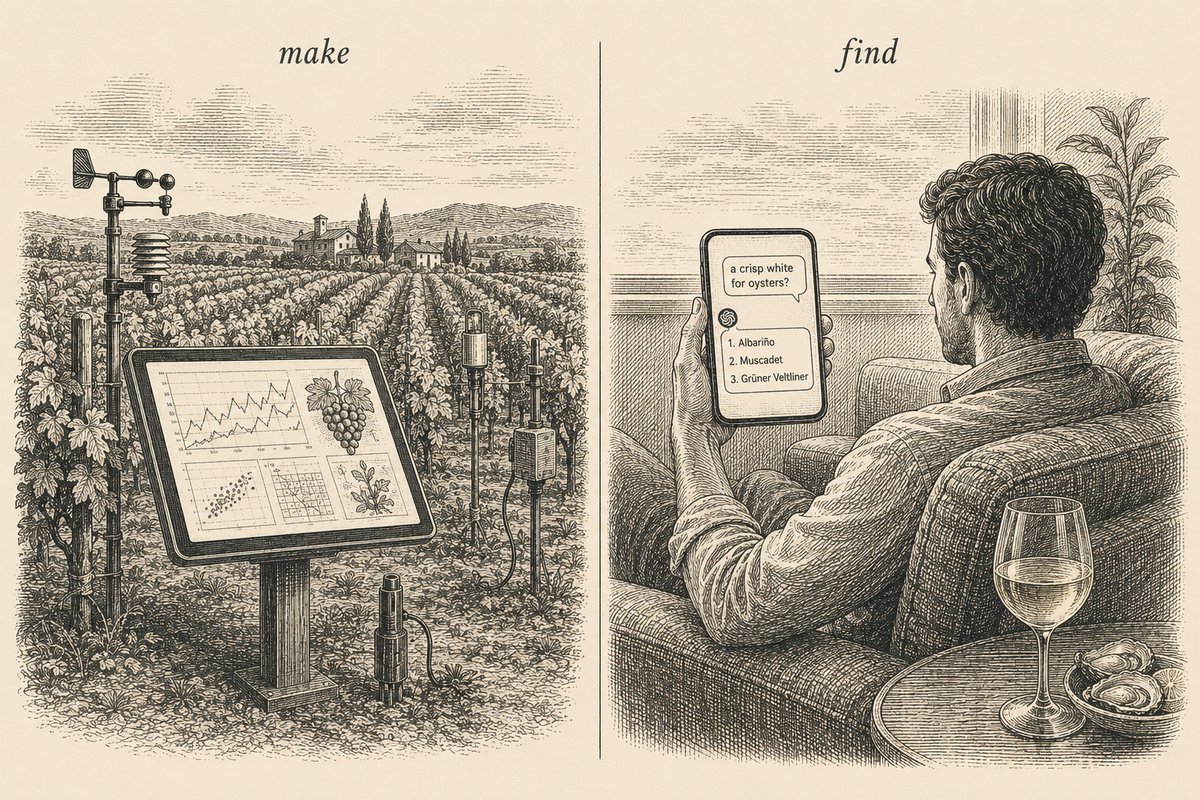
In May, the Harvard Data Science Initiative held the third edition of its “Vine to Mind” symposium at UC Davis — three days of economists, neuroscientists, winemakers, and data scientists arguing about wine through the lens of data and, increasingly, AI. Reading Felicity Carter’s account of it in Meininger’s, one thing is clear: the production side of wine is about to change profoundly, and much of it is genuinely thrilling.
The production advances were real and often thrilling: AI structuring a winemaker’s vineyard notes, “predictive winemaking” that flags problems before they appear, machine learning that pinpointed the origin of 80 Bordeaux wines with 100% accuracy, and Tastry’s models that predict taste preference. The room was full of AI that helps you make the wine — and almost none that helps a buyer find it.
If you make wine, this is your future, and it’s exciting.
But here’s what I kept waiting for and mostly didn’t find: the demand side. Not how AI helps you make the wine — how a buyer, sitting on their couch, will find it.
Because that’s already changing, faster than anything happening in the cellar. Every month, more people skip the search bar and just ask an assistant: “a red for steak night,” “a wedding gift under $200,” “a crisp white for oysters.” The AI names a few wines. And whether yours is one of them has nothing to do with how brilliantly your vineyard is instrumented — it depends entirely on whether a machine can read and understand your wine well enough to recommend it. You can have the most AI-optimized vineyard in Napa and still be invisible the moment a buyer asks.
One symposium session reportedly got heated over whether there’s such a thing as a “great” wine, or whether a “good” wine is simply one that’s fit for a particular purpose. That debate is playing out in real life every day — except the judge is now an algorithm. Buyers don’t ask AI for greatness. They ask for fit: an occasion, a budget, a pairing. The winery that wins is the one whose website answers those in plain, machine-readable terms — not the one with the most poetic tasting notes.
The Silicon Valley executives who briefed the room had one sharp piece of advice: use AI everywhere, except when it comes to serving customers — because wine is built on relationships, and nobody likes talking to a chatbot. They’re right about the relationship. But there’s a trap in it. Keeping humans at the point of sale is not the same as being findable in the first place. Discovery is already AI-mediated whether you participate or not. If the assistant never names you, there’s no relationship to have — your buyer is standing in someone else’s tasting room.
Liz Thach, a Master of Wine (MW) and president of the Wine Market Council, presented data showing wineries moving “from exploration to early integration” — using AI for marketing, finance, logistics, and, in 15% of cases, mining their wine-club databases. Good. But nearly all of that is AI pointed inward, at operations. The outward-facing question — can an AI assistant find and recommend us to a stranger? — has the shortest runway and the least attention.
The symposium was, by every account, brilliant on the supply side: making wine, authenticating it, matching it to palates. But our industry has a habit of solving the romantic problems and neglecting the plumbing. The unglamorous truth is that a winery can get everything about the making of wine right and still lose because a machine couldn’t read its website when a buyer went looking.
That’s the problem I work on. It isn’t as exciting as an AI that predicts smoke taint. But it’s the one that decides whether anyone ever tastes the wine.
Curious whether an AI can find your winery today? Run the free AI-Visibility Checklist — or see the full How to Get Your Winery Found by AI Search. Want it done for you? That’s the AI-Visibility Audit.
Source: “The AI Revolution Is Already Transforming Wine,” Felicity Carter, Meininger’s, July 2026. Zillah Bahar is the founder of COLAClear and writes about getting found by AI at GetDiscoverable.io.